


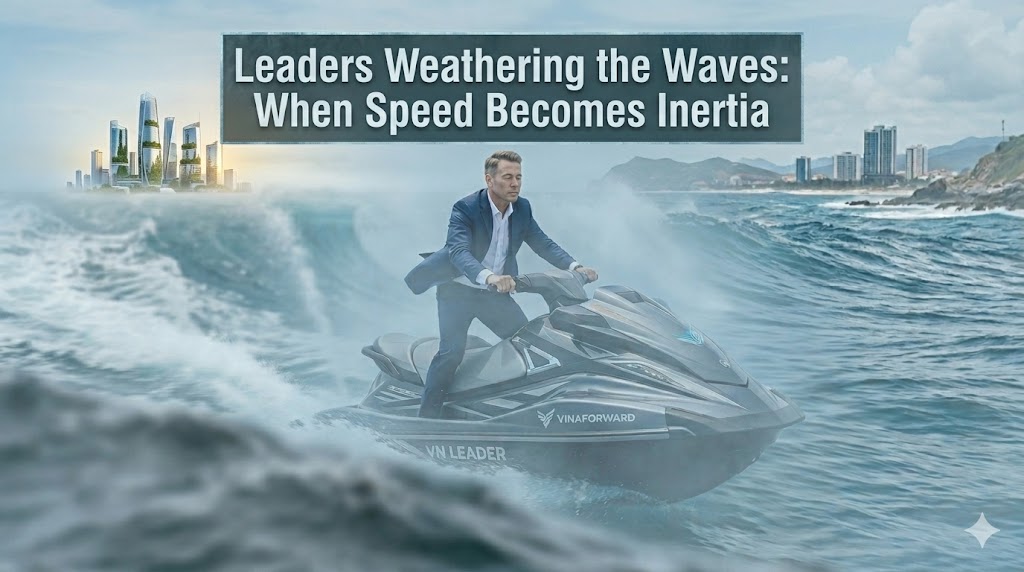
Today, I sat by the ocean. I wasn’t there to think about work, but watching the turbulent, interlocking currents, my mind drifted toward the senior leaders I have walked alongside.
From an outsider's perspective, they stand at a fierce crossroads: immediate interests, underlying conflicts, monumental expectations, and clouded information. It looks incredibly complex, but the truth is: they are used to it. High-level leaders don’t fear the waves; multi-dimensional pressure isn’t what shakes them. They have forged a "steer of steel" to stand firm at the eye of the storm.
There is, however, another type of pressure more daunting than the "difficulty" of the task itself: Relentless Intensity. When every decision is labeled "urgent," every minor issue is framed as "strategic," and there is no longer any breathing room between crises, the nervous system enters a danger zone: Reflex Mode.
Biologically, when intensity crosses a certain threshold, the brain shifts its processing from Strategic Thinking (Prefrontal Cortex) to Survival Reflex (Amygdala). When these reflexes are repeated enough, they become habit. Silently, the leader transforms into a "high-performance operational machine"—processing faster, deciding more decisively, yet losing connection with themselves just as quickly.
At this level, the problem isn’t a lack of information. On the contrary, leaders often have more data than anyone. What they lack is a different kind of clarity: Clarity regarding their own state of being.
Imagine a CEO facing declining revenue. Driven by survival reflex, they might immediately tighten discipline or implement radical layoffs to alleviate the fear of losing control. But with true clarity, they would recognize that this is a reaction of "fear," not a "strategy." They may still navigate the crisis brilliantly, but the line between a wise decision and a survival reflex begins to blur. The difference seems marginal at first, but the long-term consequence is a vast gap in trajectory.
The trap lies here: High performance masks misalignment with incredible grace. You remain successful, you hit your KPIs, and you are still applauded—until one day you wake up and realize you’re no longer sure where you’re heading.
Misalignment doesn’t start with one wrong decision; it starts the moment you stop observing yourself under pressure. It happens when you must always be the one who "knows it all" and there is no longer a space to say: "I’m not sure."

What a senior leader truly needs isn’t another expert to jump in and solve their problems. What they often lack is a space quiet enough not to have to process anything.
Clarity doesn’t come from trying to think harder; it comes from reducing the intensity enough to see through the noise: Am I reacting, or am I truly leading? This is where Coaching comes into play.
A coach doesn’t teach you how to run your business—you are already a master of that. They are there to help you manage the most sophisticated and vulnerable "engine" of all: your nervous system. Coaching provides the only safe space to temporarily set down the polished "hero" mask, allowing you to be doubtful, anxious, or confused without fear of judgment.
The greatest gift of this partnership is an objective mirror. It helps you filter the deafening "noise" of external expectations from the quiet "voice" of your inner essence.
The sea of life never stops waving. But sitting there long enough, I realized: it’s not the waves that veer us off course—it’s the inertia.
Don’t wait until your high-performance engine catches fire to start the repairs. Invest in the most paradoxical discipline of all: The Discipline of Pausing. Maintaining presence amidst high intensity is not a sign of weakness. It is the hardest discipline, and the highest hallmark of a true captain.

It’s not just how you protect your career; it’s how you protect the most human part of yourself.


