


The first 90 days of leadership is like crossing a fog-covered sea. Everything is new: the people, the culture, and the "hidden histories" that never appear in formal reports.
The most dangerous trap for new leaders is the "illusion of the solo swimmer"—the belief that asking for support is a sign of weakness. In reality, a great leader isn't the strongest swimmer; they are the navigator who masters the ship by leveraging the power of the entire system.
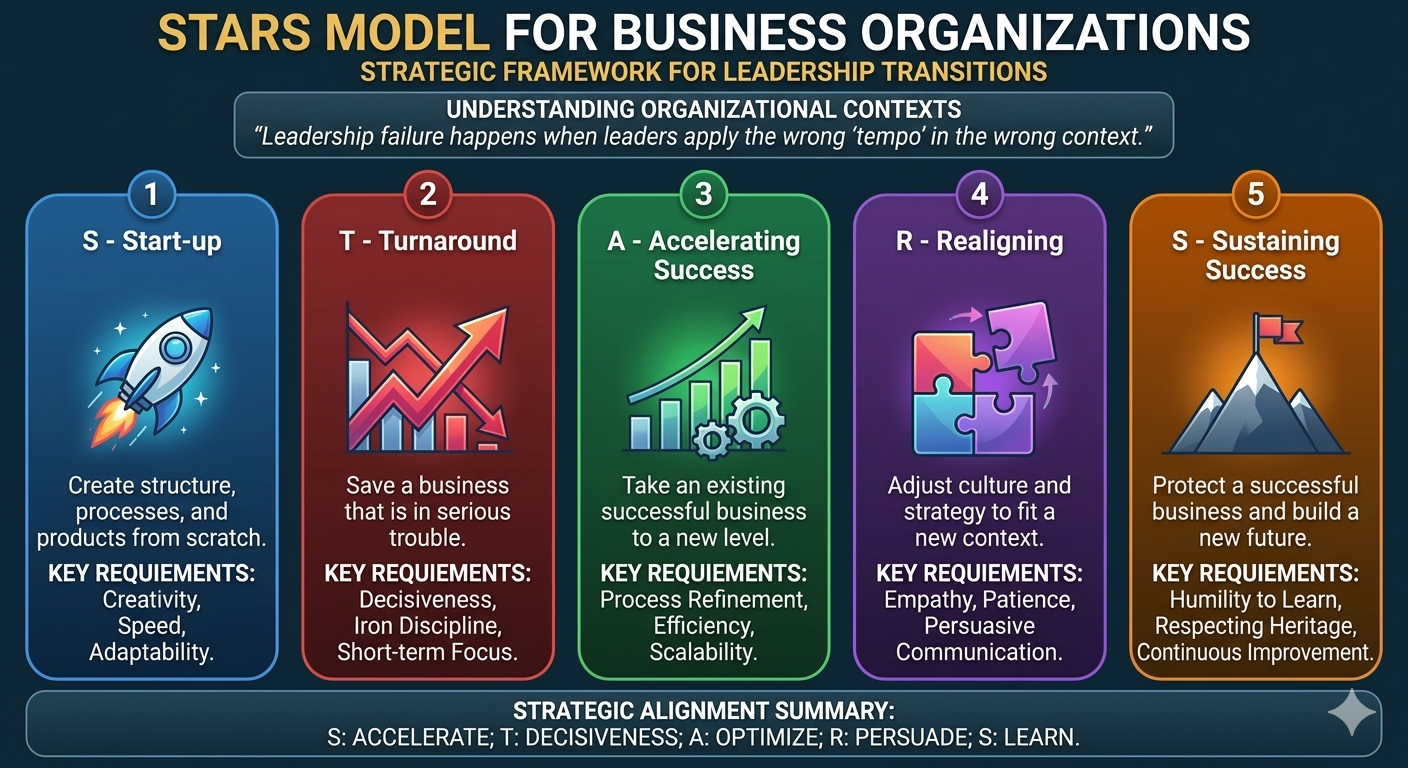
In his book The First 90 Days, Michael Watkins points out that leaders fail not due to a lack of skill, but because they apply the wrong "tempo" to the wrong context. Before acting, identify which STARS model your organization fits into:
Start-up: Requires creativity and speed.
Turnaround: Requires decisiveness and iron discipline.
Accelerating Success: Requires fine-tuning and efficiency.
Realigning: Requires empathy and patience.
Sustaining Success: Requires the humility to learn existing strengths.
Pressure often stems from vague assumptions. Patrick Lencioni emphasizes in The Advantage that organizational clarity is the ultimate competitive edge. Have direct conversations with your superiors regarding:
The Definition of Success: "After one year, which metrics will prove I’ve excelled?"
The Legacy: "What specific challenges did my predecessor face?"
The Network: "Who are the key stakeholders I need to build trust with immediately?"
You don’t just need compliance; you need the truth. Your team holds the most realistic "topographic map" of the office. Listen to discover:
What is already working well (so you don’t accidentally break it)?
What is causing the most friction for the team?
"Quick Wins": Which small changes could create an immediate positive impact?
Peers are not rivals for power; they are strategic informants. They understand the unwritten rules: Who holds real influence? Which hidden boundaries should not be crossed yet?
Max DePree once wrote: "The first responsibility of a leader is to define reality." You don’t need to prove you are better than the system; you need to make the system better because of your presence. Maturity lies in using the current to push the ship further, rather than exhausting yourself fighting against it.
When you attempt to do everything yourself in a new environment, your brain enters Cognitive Overload. The prefrontal cortex "freezes" while trying to process too many unfamiliar variables.
The Consequence: You lose creativity and become defensive.
The Solution: Leveraging the system is how you "outsource" information processing, allowing your brain to reserve energy for high-stakes strategic decisions.
The first 90 days is not an individual endurance test. It is the phase where you integrate into a living organism called the Organization. The most courageous act is not absolute independence. It is the bravery to admit: "I need this system to co-create results." When you stop swimming against the tide and start "surfing" on available resources, these 90 days will cease to be an exhausting struggle—they will become the bedrock of your future success.


